Knowledge is part
of your healing
Breathe & Bloom brings together trusted research, practical guidance, and gentle support for people navigating cancer — patients, caregivers, and loved ones. You deserve both information and care.
This website provides educational and supportive information only. It is not intended to replace professional medical advice. Always consult your healthcare provider.
We know this can feel
overwhelming
A cancer diagnosis changes everything — and it often comes with an avalanche of information, decisions, and emotions all at once. That is a completely human response. This page exists to slow things down, offer what research actually shows, and remind you that understanding your situation is one of the most empowering things you can do.
Tumor markers — what they
tell us, and what they don't
Tumor markers are substances found in your blood, urine, or tissue that may be produced by cancer cells. They help your care team monitor treatment progress and response — but they are one piece of a much larger picture.
Often elevated in ovarian cancer. Used to monitor treatment response and watch for recurrence. Levels can also rise due to endometriosis, fibroids, or inflammation — context from your doctor matters.
Carcinoembryonic antigen is used to monitor several cancers, especially colorectal. Elevated levels in a non-smoker with no infection may prompt further investigation by your care team.
Prostate-specific antigen is used for prostate cancer screening and monitoring. Rising PSA after treatment may signal recurrence, but trending direction over time is often more meaningful than a single number.
Primarily used to monitor pancreatic cancer treatment. Less useful for diagnosis alone, but valuable in tracking whether tumors are responding to therapy.
Used to monitor metastatic breast cancer response to treatment. These markers are most useful when tracked over time as part of an ongoing care plan.
Alpha-fetoprotein is the primary surveillance marker for hepatocellular carcinoma and for non-seminomatous germ cell tumors. For germ cell cancers, AFP is checked alongside beta-hCG and LDH as a three-marker panel. AFP is also naturally elevated in pregnancy, and pure seminomas do not produce AFP — your care team will always consider the full clinical picture.
Human chorionic gonadotropin (beta subunit) is produced by certain germ cell tumors, including some testicular and ovarian cancers. It is part of the standard surveillance panel for germ cell survivors, tracked alongside AFP and LDH. A rising beta-hCG in a survivor is one of the most important signals to act on.
Lactate dehydrogenase is a nonspecific enzyme that rises in many conditions, but it serves as a tumor-burden indicator in germ cell cancers and certain lymphomas. For germ cell survivors, LDH is tracked alongside AFP and beta-hCG as part of the surveillance panel. Higher levels may suggest greater tumor burden.
Lifestyle choices that
research supports
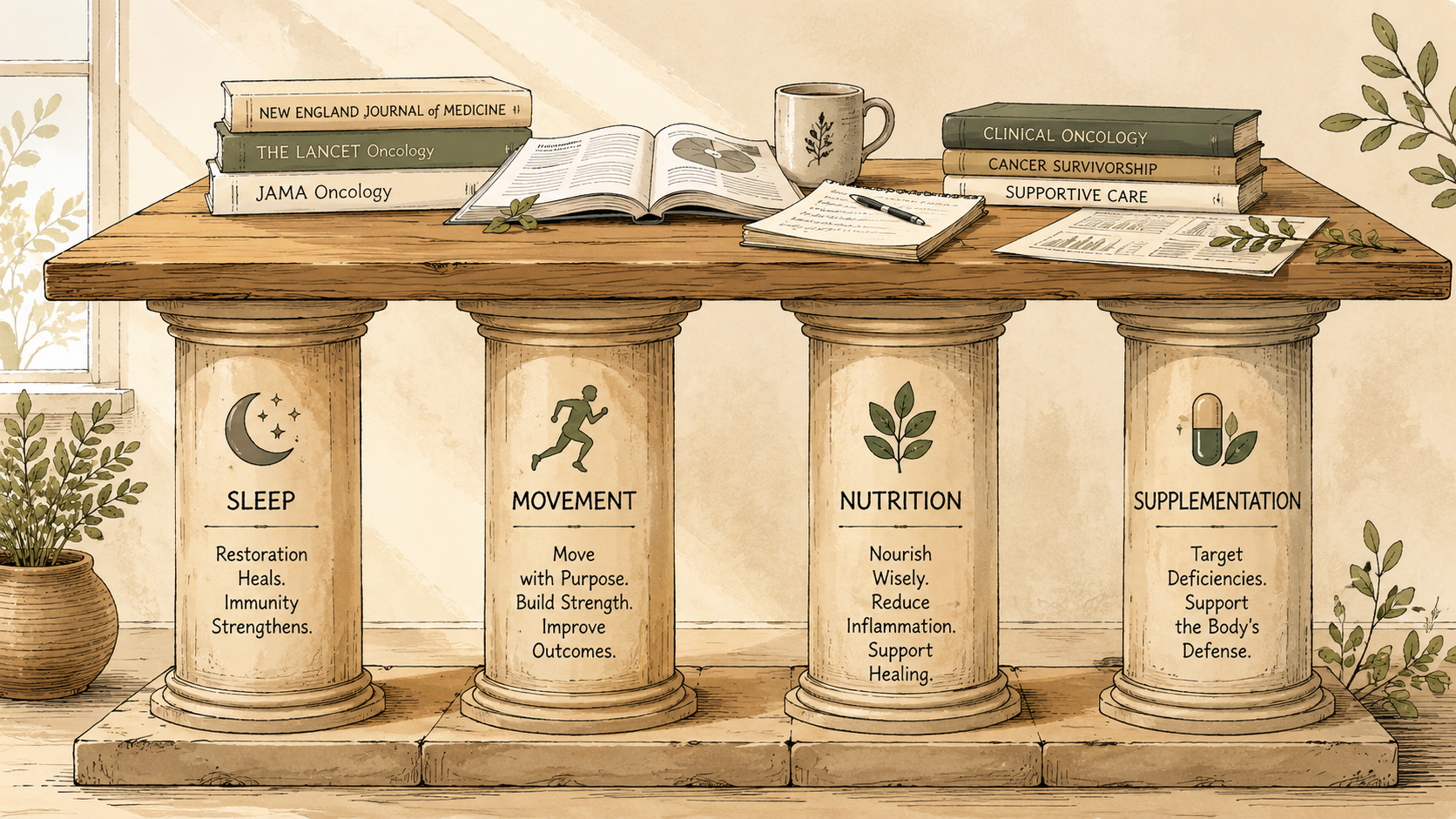
While no lifestyle change replaces medical treatment, a growing body of research shows that how we sleep, move, eat, and shape the environment around us can meaningfully support treatment outcomes and quality of life. Breathe & Bloom is built around these four pillars.
Sleep
Sleep is the body's primary window for cellular repair and immune calibration — not a luxury. For people in cancer treatment, protecting sleep quality has measurable, near-immediate effects on the immune system.
- A single night of partial sleep deprivation can reduce natural killer (NK) cell activity to 72% of baseline — the frontline immune cells responsible for tumor surveillance
- 7–9 hours of consistent, circadian-aligned sleep is associated with better treatment tolerance, lower inflammatory markers (CRP, IL-6), and improved metabolic stability
- Cognitive Behavioral Therapy for Insomnia (CBT-I) is the first-line treatment for chronic insomnia per the American College of Physicians and American Academy of Sleep Medicine — and outperforms sleep aids in cancer patients in repeated trials
- Practical anchors: cool, dark, quiet bedroom (65–68°F); no screens 1 hour before bed; morning light within 30 minutes of waking; consistent bedtime and wake time including weekends
Sources: Irwin et al. (Psychosomatic Medicine 1994; FASEB Journal 1996; Archives of Internal Medicine 2006; Biological Psychiatry 2016) · Spiegel et al. (Journal of Applied Physiology 2005) · Savard et al. on CBT-I in oncology · Zhang et al. (International Journal of Public Health 2025)
Movement
Exercise is one of the most evidence-backed supportive interventions for people living with cancer — even in small amounts.
- 150 minutes of moderate activity per week recommended for cancer survivors by ACS and ASCO
- Exercise reduces cancer-related fatigue more effectively than rest alone
- Resistance training helps maintain muscle mass often lost during treatment
- Even gentle walking for 10 minutes improves mood, circulation, and energy levels
- Yoga and tai chi shown to improve sleep quality and reduce anxiety in multiple RCTs
Sources: ASCO 2022 Exercise Guidelines, Courneya et al., Journal of Clinical Oncology
Nutrition
Research consistently points to a plant-forward, anti-inflammatory diet as supportive of immune function and cancer recovery.
- Mediterranean-style eating linked to reduced recurrence risk in breast cancer survivors (JAMA, 2022)
- Cruciferous vegetables (broccoli, kale) contain sulforaphane, studied for anti-tumor properties
- Limiting processed meats and ultra-processed foods reduces inflammatory markers
- Staying well hydrated supports kidney function during treatment
- Ginger tea has shown measurable reduction in chemotherapy-induced nausea in clinical trials
Sources: ASCO Nutrition Guidelines, WCRF 2022, JAMA Oncology
Environment
The conditions inside and around you — reducing what burdens the body and correcting what the immune system is genuinely missing.
- Much of the immune system is shaped by environment and daily life rather than genes — which means the terrain can be changed
- Alcohol is an established, modifiable cause of cancer and can complicate treatment (American Society of Clinical Oncology)
- Stopping smoking at or around diagnosis is associated with better survival
- Correcting a true deficiency helps — and how matters: daily vitamin D with your team's guidance, not mega-doses
- More is not safer — high-dose antioxidant supplements during treatment have caused harm in trials; discuss any supplement with your oncology team
Sources: Brodin 2015 (Cell); LoConte 2018 (ASCO); Kuznia 2023; and studies cited in Breathe & Bloom
Breathe & Bloom
The four-pillar protocol on this page is the spine of an over 60,000-word, fully cited book by Sonja.
Every clinical claim is drawn from peer-reviewed research. Every chapter ends with a short, actionable summary. Every protocol is designed to work alongside your oncology team — never instead of them.
Managing common symptoms
with what we know works
These approaches are evidence-informed and used widely in integrative oncology. They complement — never replace — your medical treatment plan.
Nausea
One of the most common treatment side effects — and one of the most studied.
Sources: Zick et al. (2009), Cochrane Review on acupressure, ASCO antiemetic guidelines
Fatigue
Cancer-related fatigue affects up to 90% of patients — and is distinctly different from ordinary tiredness.
Sources: NCCN Cancer-Related Fatigue Guidelines, Bower et al. JAMA Oncology, 2019
Comfort & Calm
Research in environmental psychology and integrative oncology shows that our surroundings and routines matter for healing.
Sources: Ulrich (1984), Carlson et al. JAMA Oncology, Kabat-Zinn MBSR research
Research worth knowing about
These are real studies and clinical guidelines from trusted sources. We summarize them here so you can bring informed questions to your care team.
ASCO Integrative Oncology Guidelines (2022)
The American Society of Clinical Oncology issued landmark guidelines formally recommending integrative approaches — including acupuncture, mindfulness, yoga, and massage — as part of standard cancer care for symptom management.
Lyman et al., Journal of Clinical Oncology, 2022 · asco.org
Exercise Reduces Recurrence Risk in Breast Cancer
A meta-analysis of 67 studies found that physically active breast cancer survivors had a 40–50% lower risk of cancer recurrence and cancer-specific mortality compared to inactive survivors.
Ibrahim & Al-Homaidh, Breast Cancer Research and Treatment, 2011 · Updated in ASCO 2022 guidelines
MBSR Reduces Anxiety & Cortisol in Cancer Patients
Mindfulness-Based Stress Reduction (MBSR) significantly reduced anxiety, depression, and salivary cortisol levels in cancer patients across multiple randomized controlled trials, with benefits persisting at 6-month follow-up.
Carlson et al., Journal of Clinical Oncology, 2013 · Psycho-Oncology meta-analysis, 2019
Mediterranean Diet & Cancer Recurrence
A study of 1,005 breast cancer survivors found those adhering to a Mediterranean dietary pattern had significantly lower all-cause mortality and improved disease-free survival over a 7-year follow-up period.
Castello et al., JAMA Oncology, 2022 · World Cancer Research Fund
One Night of Sleep Loss Cuts NK Cell Activity
Landmark studies showed that a single night of partial sleep deprivation reduced natural killer (NK) cell activity to 72% of baseline, with follow-up work demonstrating that chronic sleep loss activates inflammatory pathways linked to tumor progression. Cognitive Behavioral Therapy for Insomnia (CBT-I) has repeatedly outperformed sleep aids in oncology trials.
Irwin et al., Psychosomatic Medicine (1994), FASEB Journal (1996), Archives of Internal Medicine (2006) · Savard et al. on CBT-I in cancer patients
Psychosocial Support Improves Survival
A landmark meta-analysis found that psychosocial interventions — including support groups, individual counseling, and educational programs — were associated with longer survival in cancer patients, not just improved wellbeing.
Fawzy et al. & Spiegel et al. · Updated in Cochrane Reviews on psychosocial cancer support
All research summaries are simplified for readability. Please read original sources and discuss findings with your care team before making any changes to your health plan.
Need a moment?
Reading through all of this takes courage. If you'd like a quiet space to process how you're feeling — not for medical answers, just to breathe and be heard — our Support Companion is here whenever you're ready. No pressure, no expectations.
Emotional support only · Not medical advice